


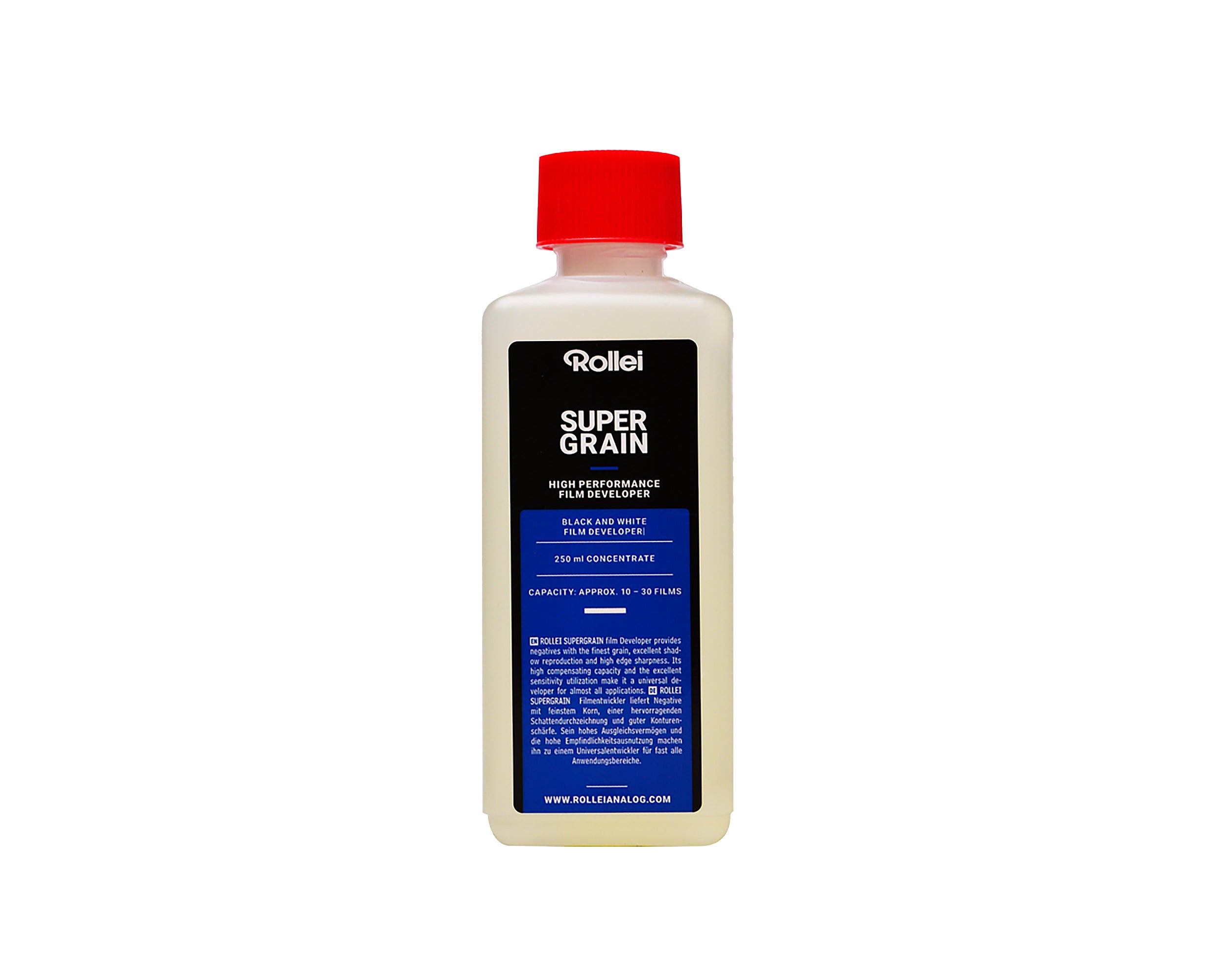
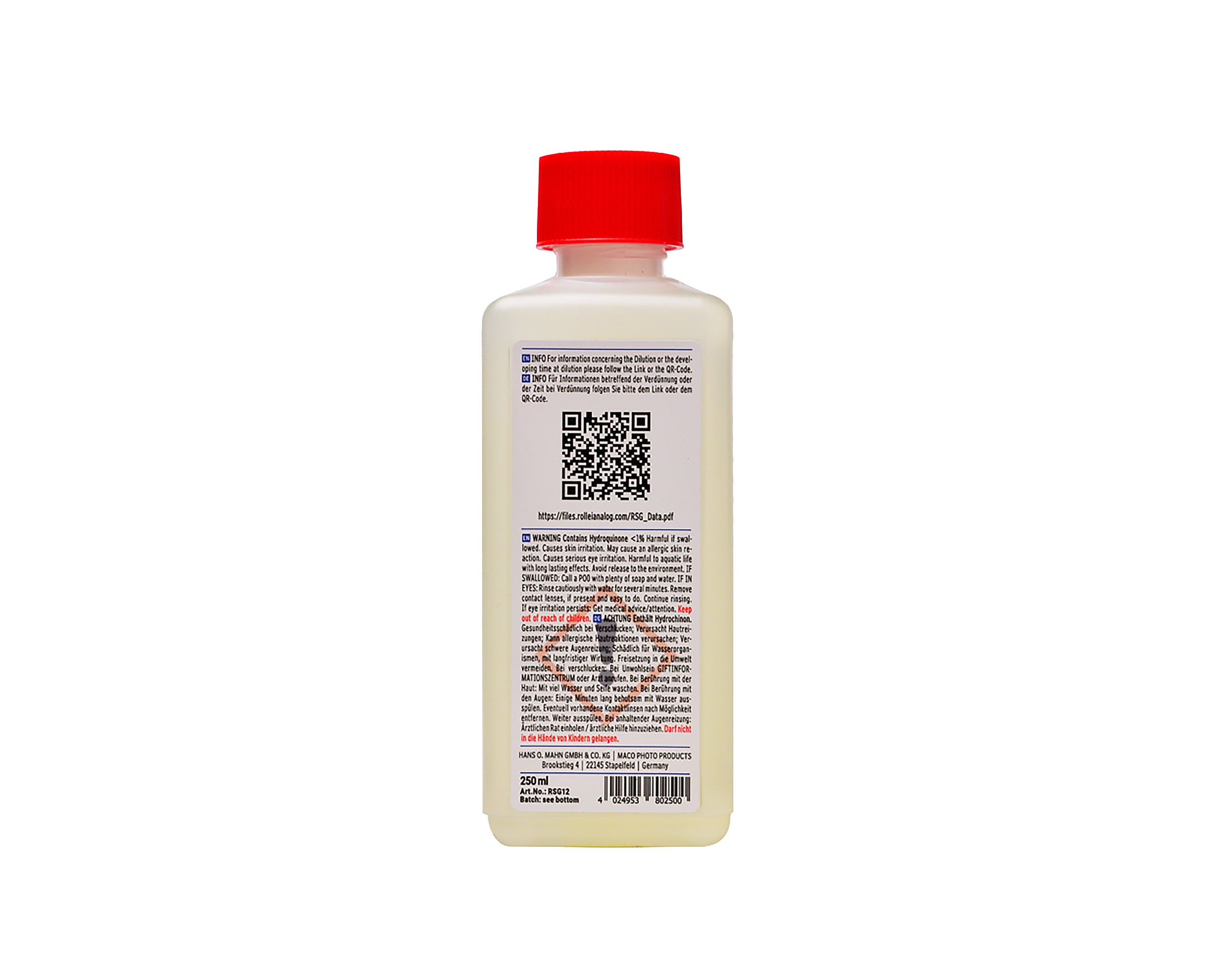
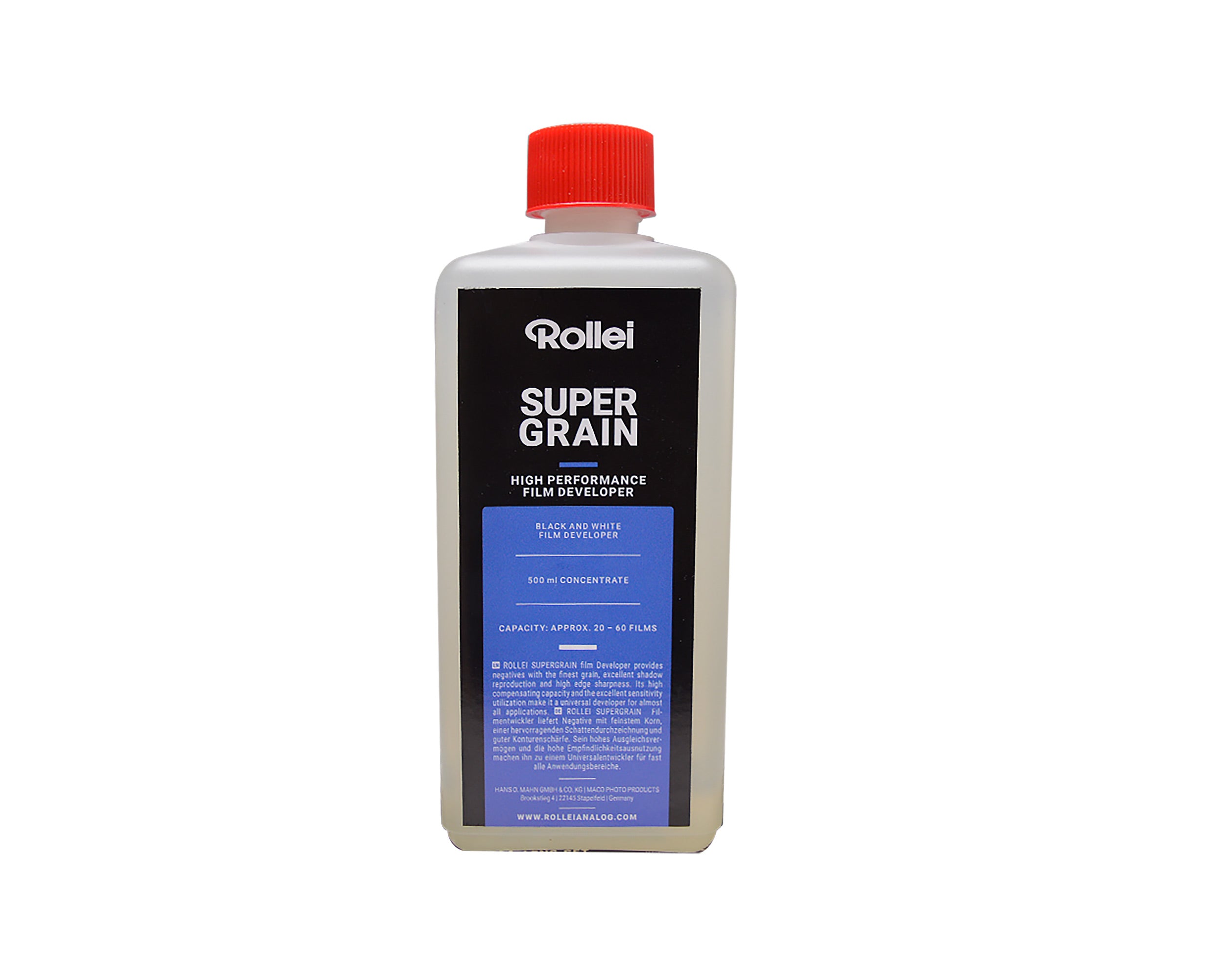
Rollei Supergrain 500ml
Legal Guarantee
Statutory legal guarantee applies.
More information
Rollei Supergrain – Fine Grain Developer for Black-and-White Films
Rollei Supergrain is a highly concentrated fine grain developer designed for all classic black-and-white films. It has been specially formulated to deliver maximum sharpness, excellent edge definition, and the finest tonal gradation – while ensuring high effective film speed and outstanding fine grain structure.
Its unique formulation makes Supergrain the ideal developer for demanding applications in portrait, architecture, and landscape photography. It delivers high-contrast yet nuanced results and brings out the full potential of modern film emulsions.
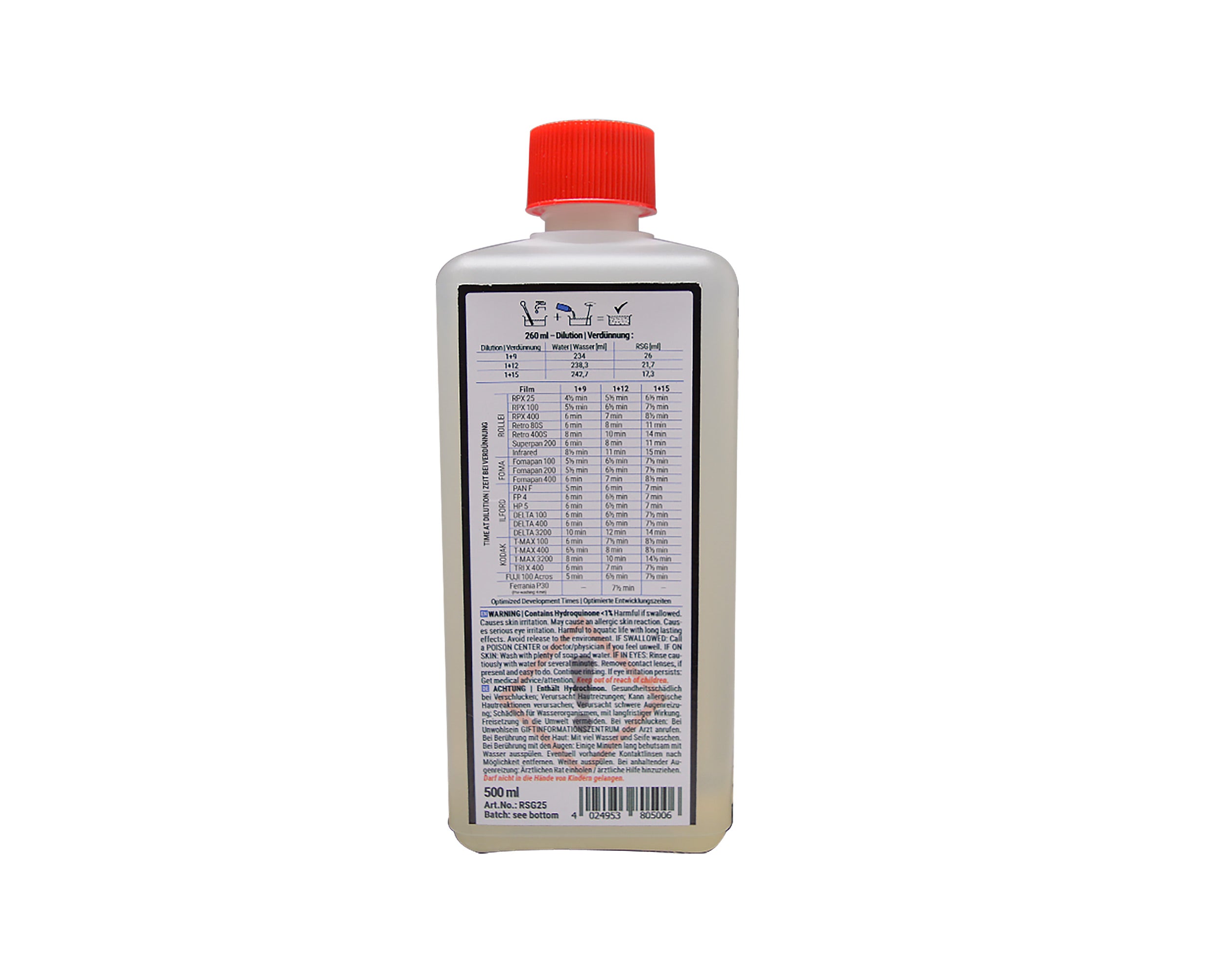
Supergrain is particularly well-suited for classic films such as Rollei RPX 25 / 100 / 400, Retro 80S / 400S, Ilford HP5+, Kodak Tri-X, and high-speed specialty films. It is typically used at a dilution of 1+12 – producing finely detailed, expressive negatives with a clear visual language.
Features:
- Highly concentrated fine grain developer for black-and-white films
- Excellent edge sharpness and fine detail rendering
- Neutral image tone with outstanding tonal reproduction
- High effective speed with fine grain
- Ideal for portrait, landscape, and architectural photography
- Compatible with both classic and modern films
- Typical dilution: 1+12 (adjustable depending on film and contrast preferences)
- Suitable for inversion and rotary processing
Available sizes:
- 250ml – for occasional use and testing
- 500ml – for regular processing or larger batches
Pairs well with
Rollei Supergrain 500ml
If you have any questions, we're happy to assist you!
You can contact us anytime – we usually reply within 1–2 business days.
-
Customer Service
Not sure about a product or have a specific question?
Just send us an email at hello@rolleianalog.com – we’re happy to help.
Or give us a call at +49 (0)40 23700 888 (Mon–Fri, 9:00 AM – 4:00 PM CET). -
Shipping Information
Shipping costs are calculated live in your cart based on your delivery address and selected shipping method.
For full details on delivery times, carriers, and international shipping, please refer to our Shipping Information page. -
International Shipping
We ship worldwide! If you're ordering from abroad and have questions about delivery, customs, or returns – feel free to get in touch with us.
FAQs
What do I need to develop black-and-white film?
For classic black-and-white film development, you need three baths:
Developer – makes the exposed image visible
Stop bath – stops the development process
Fixer – stabilizes the image and makes it light-resistant
With the Rollei Film Chemistry Kit, you get all three components in one perfectly matched set:
- Rollei RSG = developer
- Rollei RCS = stop bath (citrate-based, low odor)
- Rollei RXA = universal fixer
A compact solution for everyone who wants to develop black-and-white film at home – easy to use and precise in results.
Which chemistry is suitable for color film?
Color films require special development processes. For color negative film, this is the C-41 process.
The Rollei Colorchem C-41 Kit contains all essential components – color developer, bleach-fix (blix), and stabilizer – precisely balanced for safe processing at 38 °C. It delivers color-accurate negatives with fine grain and good longevity.
Note: Slide films (reversal films) require a different process – the E-6 process, which is more complex and not compatible with C-41.
How long do photo chemicals last?
It depends on the type of chemical, how it’s stored, and whether it’s been opened:
- Unopened concentrates: usually last 1–2 years if kept in a cool, dark place
- Opened concentrates: can last a few weeks to several months, depending on air exposure and storage
- Mixed working solutions: are typically good for a few days to a few weeks
Pro tip: If it smells off, changes color, or shows sediment – it’s probably time to toss it. For maximum shelf life, always store your chemicals airtight, cool, and away from light.
Can I reuse photo chemistry?
Yes, many photo chemicals can be reused – especially fixers, stop baths, and some developers.
The exact number of uses depends on the type of product, dilution, and volume of material processed.
Fixers can even be regenerated – for example, by adding fresh concentrate or a dedicated replenisher.
This is especially worthwhile if you're processing frequently and want to maintain consistent performance over time.
With developers, regeneration is more difficult: many are sensitive to oxidation and lose activity with each use.
A simple top-up usually isn’t enough – fresh working solutions are generally the more reliable choice.
Stop baths are typically replaced once the pH level shifts (e.g., when a color indicator changes, as in citrate-based stops).
Pro tip: If you process regularly, it’s helpful to track your usage (e.g., number of rolls or prints) to know when to refresh or regenerate your chemistry.
How do I properly dispose of used photo chemicals?
Photo chemicals should never be poured down the drain or thrown in the trash!
They contain substances that can harm the environment – especially fixer, which may contain residual silver. Used chemistry should be taken to a hazardous waste collection site or local recycling center. In some regions, labs or photo retailers also offer disposal services.
Pro tip: For small quantities, collect the chemicals in tightly sealed and clearly labeled containers and dispose of them all at once. Always follow your local regulations for disposing of photographic and lab chemicals.